Case study
Lead Architect & Developer·October 2024 to Present
FlowOne: AI Agent Orchestration Platform
Lead architect of an AI-native SaaS platform with Agent Studio, Workflow Studio, and Voice AI. Real-time WebSocket voice pipeline (STT → LLM → TTS) with ElevenLabs and Twilio, omnichannel integrations, and a multi-tenant FastAPI backend.
01
Overview
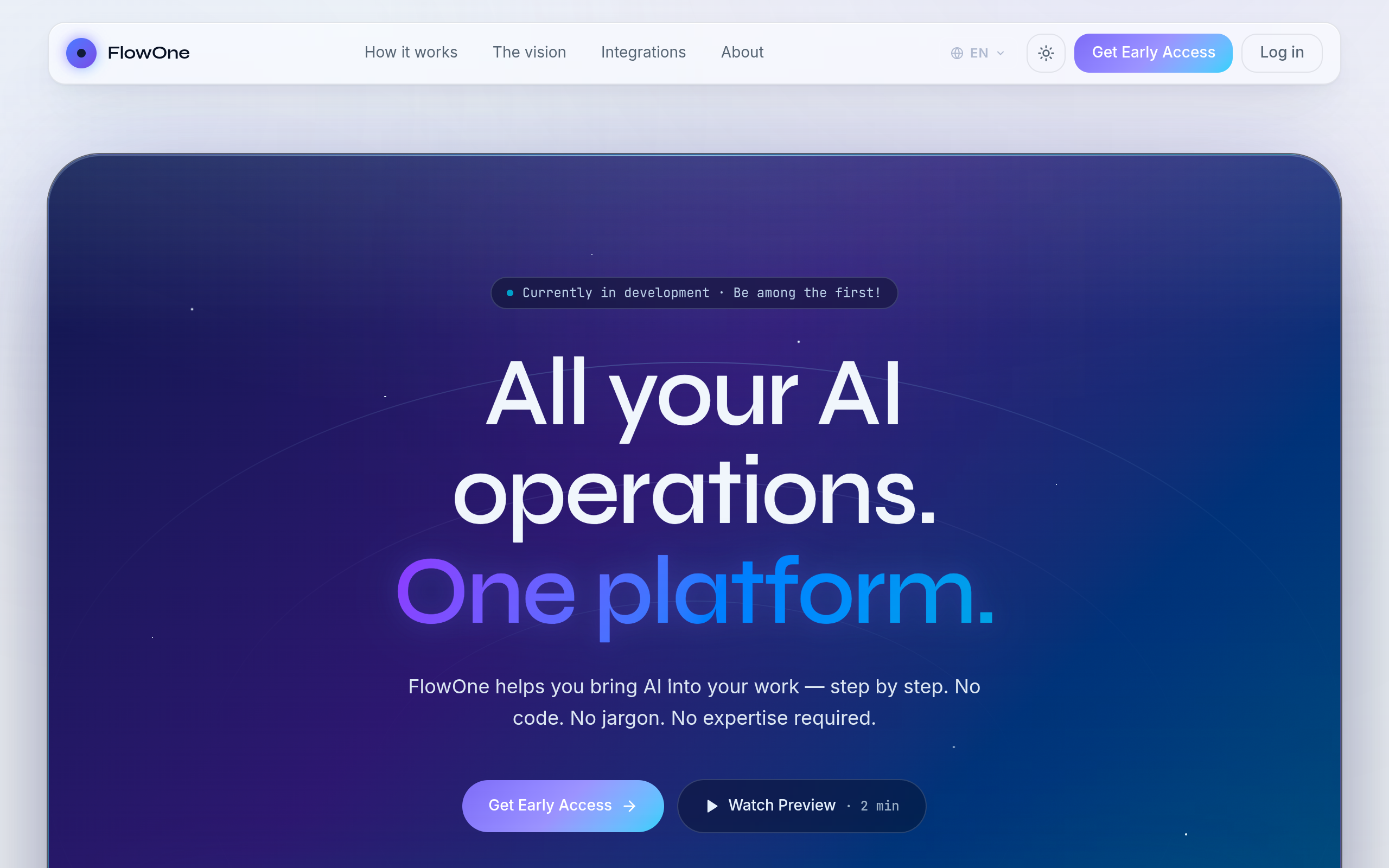
FlowOne is an AI-native SaaS platform I lead as architect and developer, bringing an Agent Studio, a Workflow Studio and Voice AI together in one product. It was built to take agentic AI from a demo into something enterprises can actually run in production.
02
The challenge
Teams building AI products were stitching together disconnected tools: a chatbot builder here, a workflow automation platform there, a separate voice AI vendor. No single system owned the full agent lifecycle from design to deployment.
03
The approach
I designed FlowOne as one AI-native platform: an Agent Studio and Workflow Studio for building and orchestrating multi-agent systems, a real-time voice pipeline for phone and voice channels, and omnichannel messaging, all on a multi-tenant FastAPI backend built to scale to enterprise deployments.
04
How it works
Inbound events land on channel adapters (WhatsApp Business API, web chat, Twilio voice). A workspace-scoped RAG layer (PostgreSQL + pgvector) retrieves tenant knowledge. Agent Studio plans tool calls; Workflow Studio (LangGraph) runs multi-step graphs. Voice is a dedicated WebSocket pipeline: STT → LLM → ElevenLabs TTS, transported over Twilio. Auth, workspaces, and billing sit in a multi-tenant FastAPI core so every tenant is isolated without forking the runtime.
05
System architecture
How the pieces talk to each other. Hover a node, or switch to the source that drives the runtime.
Channels
Orchestration
Runtime
06
What I built
End-to-end platform architecture: Agent Studio, Workflow Studio, and Voice AI as one product.
Real-time STT → LLM → TTS voice path over WebSockets with ElevenLabs and Twilio.
Omnichannel adapters: WhatsApp Business API, shared inbox, and web chat on the same agent runtime.
Multi-tenant FastAPI backend covering auth, workspaces, isolation and third-party API integrations.
RAG over PostgreSQL so each workspace retrieves only its own knowledge.
07
Outcomes
Architected a modular multi-agent platform with RAG pipelines, tool-calling workflows, and enterprise automation capabilities.
Engineered a real-time WebSocket voice pipeline (STT → LLM → TTS) using ElevenLabs and Twilio.
Built omnichannel integrations including WhatsApp Business API, Shared Inbox, and Web Chat.
Built a scalable backend using FastAPI, PostgreSQL, Docker, and WebSockets.
Developed secure authentication, workspace management, and third-party API integrations.
Implemented multi-tenant architecture and modular backend services for scalable enterprise deployments.
08
Results
A single control plane for agents, workflows, and voice instead of three disconnected vendors.
Production-shaped multi-tenancy: one codebase, many isolated workspaces.
Voice and chat share the same tool-calling agents, with no parallel ‘voice bot’ fork.
09
What I learned
Agent demos fail in production at tenancy, evals and latency. Those were first-class concerns from day one.
Voice needs a streaming pipeline, not a request/response chatbot wrapped in a phone number.
Tool-calling without retrieval is a confident liar; RAG has to be workspace-scoped.
10
Tech stack
Have something similar in mind?
I'm open to new projects. Let's talk about what you're building.